 Introduction to Animation
 BOUNCING
BALL 2...
BOUNCING
BALL 2...
Now that we know the bouncing ball, we can apply some of its principles such as squash, stretch, arcs, slo-ins, and slo-outs to other actions and shapes.
Step 1
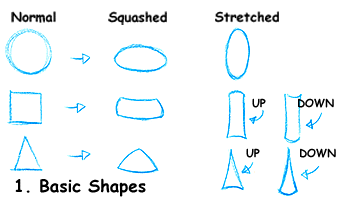
We see the rubber ball SQUASH and STRETCH. Now squash and stretch other basic shapes such as squares and triangles.
TIP: Always try to maintain the volume, i.e., the area within a form
Step 2
Let's have some more fun using SQUASH and STRETCH with more developed figures. The ball and the cube go from normal to squash then stretch, but you can also go from normal to stretch then squash, as shown in the car example below.
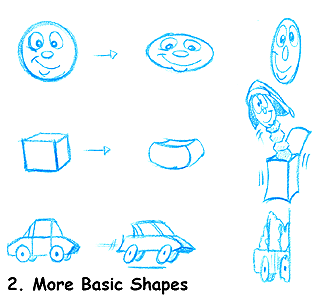
TIP: Work ruff with basic shapes. The add the details last. The details, i.e., mouth, nose eyes, squash and stretch too.
Step 3
Timing is important. Keep in mind the movement of a pendulum. It does a SLO-IN and SLO-OUT at the begining and end of each swing. NOTE: The PATH OF ACTION of the pendulum is an ARC. The same movement applies to the swinging door below. |
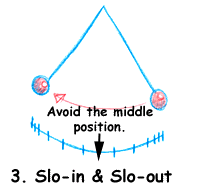 |
TIP: Try to avoid the "middle" position of the arc. Strong verticals stop the action or become neutral.
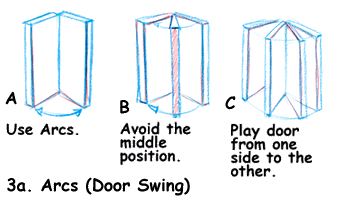
Now apply this information to a simple action such as a swinging door. Play the door to one side of the middle position or the other. Use arcs, set your tic marks, and avoid the middle position. Begin movement with a SLO-IN and end with a SLO-OUT.
TIP: In the case of a slamming door, you will have a SLO-IN but no SLO-OUT. This is because a slammed door stops abruptly. Actions will always begin with a SLO-IN unless an object enters the frame already AT SPEED (in motion).
Step 4
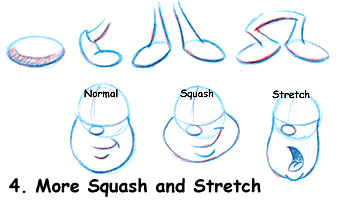
SQUASH is a great way to show the object's or character's weight. Note the weight in the feet above. The heavier the character, the more squashed the feet will look.
The weight (or squash) is based on on three elements:
- The substance of the object or character -- is is rubber, metal, flesh, what?
- The speed at which it travels and its impact.
- The actual weight of the object.
TIP: Start with simple shapes and add to them. Details are added last, as shown above with the face.
Here's one more thing to ponder as you create your simple animation. Facial movements during dialogue will SQUASH and STRETCH according to the movements of the jaw and the muscles in the cheeks.
Review
KEY POINTS
|
TIPS
|
| To Next Page |