 Introduction to Animation
 BOUNCING
BALL
BOUNCING
BALL
The bouncing ball includes many aspects of animation that an animator uses everyday in every scene on which he works. Animation principles such as the path of action, arcs, momentum, timing, key drawings, inbetween drawings, weight, speed, and the substance of an object are included in this simple exercise.
Step 1
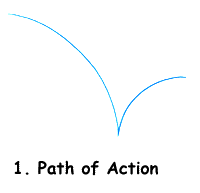
Let's begin by drawing a path of action from left to right. This is the path the ball will follow. Remember to stay "ruff" and "loose" with your drawings. As is the case with most animation, our path of action is made up of ARCS. TIP: Most objects, characters, etc. move in ARCS and NOT in straight lines. |
 |
Step 2
Next we will plan the timing of the ball along our path of action. Draw tick marks. This will help us figure out the positions (on the arc) of the ball and the timing of the bounce. Tick marks at the beginning (the top of the arc) are close together; as the ball heads down, the tick marks become further and further apart. |
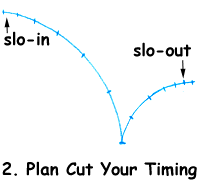 |
The action at the beginning of an arc is called a "slo-in". Once the ball hits - it looses a little momentum and then slows down (slo-out) as it approaches the top of the next arc.
TIP: Think of a ball rolling down a hill. It gains speed. Now we have created a guide for our timing.
Step 3
 |
 |
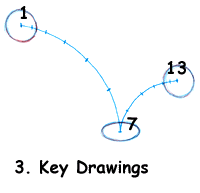
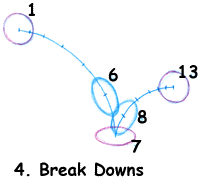
We'll "ruff" in our key drawings. Key drawings (or key poses) are at the beginning and at the end, and wherever the character, object, etc. changes direction. Our key drawings are #1, #7, and #13.
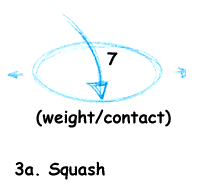
NOTE: Drawing #7 is where the ball makes contact, or impacts with the ground. #7 is the "squash" drawing, i.e., where we show the illusion of weight or impact of the object (3a).
TIP: The illusion of weight is very important. To maintain the integrity of the ball, be sure to maintain the same volume in drawing #7 (even though it is "squashed") as you have in drawings #1 and 13. Also, the faster the object, character, etc. moves, the more "squash" you have when it hits.
Step 4
 |
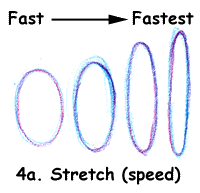 |
Next we add the breakdown drawings (#6 and #8). "Breakdowns" are really inbetween drawings which help describe the action. These drawings (known as "inbetweens" or "tweens") are the drawings between the pose or key drawings. In the hiarchy of animation, first you do the key drawings (or keys), next the breakdowns, and finally any further inbetween drawings needed to smooth out the action. The breakdowns for the bouncing ball show the illusion of speed. These are the "stretch" drawings. The stretch(speed) and squash(weight) drawings are relative to each other. Generally, if you have a lot of squash, you have a lot of stretch, too.
TIP: Notice that the ball goes from stretch directly to squash and back to stretch (# 6, #7, #8) with no "transition drawings". This gives snap to the ball's bounce.
Step 5
| Finally, we draw in the rest of the inbetweens - #2 to #5; and #9 to #12. Notice that as the ball falls, the shape "transitions" from a round ball to more and more of an eliptical or stretched shape. | 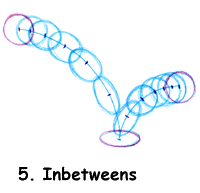 |
As the ball bounces up, it "transitions" from the stretched shape back to the round shape. There you have it -- the plan for a bouncing ball. Of course, each individual drawing would be placed on a separate piece of animation bond (paper).
Review
KEY POINTS
|
TIPS
|