Lesson 26- Secondary Dominant
Triads
In Lesson
15, you learned what dominant triads were and how to form
them. You should review that lesson if you are unclear about such
triads, because a clear understanding of dominant chords is essential
to create what we call secondary dominants.
By way of a brief review, you know that dominant
chords are built on the fifth degree of a scale, and must be major
in quality. This is because in a dominant chord, the 3rd of the chord
acts as a leading-tone to the tonic. For example, in C-major,
the dominant chord is a G-major chord. The 3rd of the G chord ('B')
is a leading-tone to the tonic. And the most important feature of
dominant chords is that they "point to" the tonic. To use the vernacular,
they "sound like they want to go to" the tonic. The root of the tonic
chord is a fourth above, or a fifth below, the dominant, and that's
the chord that the dominant wants to move toward. Study and listen
to this example:
 Listen to the
progression: Listen to the
progression:
Listen to the 3rd resolving
upward:
This much should be common knowledge to you, as it was
covered in Lesson 15. You should note
that it is not essential for the V-chord to resolve to a I-chord;
it would still be a V-chord no matter to what chord it resolved. If
a V-chord moves somewhere other than the I-chord at a cadence, that
would produce what is known as a "deceptive"
cadence- for obvious reasons!
So that explains dominant chords. What about
secondary dominant chords? Secondary dominant chords make a
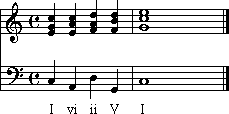
note other than the tonic sound like a tonic. Study this
progression:

It is the ii-chord that we want to focus on here. In
the major key, the ii-chord is always a minor chord. But what if we purposely change the ii-chord so that it is
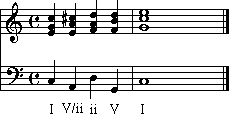
a major chord? We would do that by raising the 3rd of the chord-
by making the 'F' an 'F#'. The result would look and sound like this:
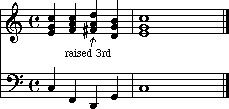
The D chord, which is now major, presents a bit of a
"surprise" to our ears. In our western culture, we are very quick at
picking up tonality. Even with just the first two chords, we hear
the key of C-major as a strong possibility. We expect a minor chord when
we hear a chord whose root is based on the second note of that scale. This
is a cultural response, not an academic response. So when we
hear a major chord whose root is the second note of a scale, it's a
bit unexpected. But despite its unexpectedness, our ears tell us something
right away about that chord- that the minor quality has been changed to
major for the purpose of creating a leading tone. Specifically, the
'F' has been raised to 'F#'. The F# sounds like a note that wants to
resolve upward.
You can readily see that the D chord now has the same
characteristics as those of a dominant chord: 1) it is major,
possessing a leading tone that wants to resolve upward, and 2) its root is
a fifth above, or fourth below, the resolution chord. For
now, a question mark has been placed under the chord in the graphic below:
since ii-chords must be minor in a major key, and this chord is now major,
we have to find a new name for it, which we will later in this
lesson:
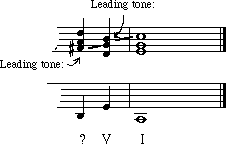
In the two ways that matter, this "major ii-chord"
operates as if it were a V-chord. If it were a V-chord, what chord
would it be trying to make sound like a tonic? Since V-chords make the
chord whose root is a fourth higher (or fifth lower) sound like the tonic,
we would say that it is a V-chord of the V-chord. The proper way to
indicate this is with the following symbol: V/V. When we see V/V, we say,
"five - of - five". When we say "V/V", we know that we mean a ii-chord
that has been adjusted to be major. A V/V is a type of chord that we call
secondary dominant.
So a V/V makes the V-chord sound, even just very
briefly, like a tonic chord. In fact, many composers use V/V, or other
secondary dominant chords, to change the key of a piece of music, what we
call "modulate". If you wrote a piece in C-major, and decided that for
interest's sake you would modulate to G-major, a V/V might be a
chord you would choose to make the G-chord sound like a tonic instead of a
dominant.
Here are some chord progressions. The progressions in
the left hand cells of the table use ii-chords. In the right hand cells of
the table, the ii-chords have been changed to V/V, by making the ii-chords
major. Play each example and make certain that you can hear the
difference.
You have now seen how a ii-chord can be modified to resemble a V-chord.
This same process of making minor chords major can be done to any of
the naturally-occuring minor chords in any key, major or minor. We know
that in a major key a iii-chord is minor.
If we make it major, our ears tell us that a leading tone has been created,
and we are therefore creating a secondary dominant.
Here is a iii-chord in Bb-major:  As you can see, it is a minor triad. Here is that
same triad, modified so that it is now major: As you can see, it is a minor triad. Here is that
same triad, modified so that it is now major: 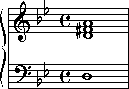 The note 'F' has been raised to 'F#'. Our ears
hear that the purpose of this raising is to create a leading tone.
If 'F#' is acting as a leading tone, to which note is it leading?
'F#' is a leading tone to 'G'. In our key (Bb-major), a G-chord would
be a vi-chord. So the D-major chord is acting as a dominant of the
vi-chord. We would label that chord: V/vi and call it "five of six".
Here are two progressions, one using a iii-chord, the other using
a V/vi in its place: The note 'F' has been raised to 'F#'. Our ears
hear that the purpose of this raising is to create a leading tone.
If 'F#' is acting as a leading tone, to which note is it leading?
'F#' is a leading tone to 'G'. In our key (Bb-major), a G-chord would
be a vi-chord. So the D-major chord is acting as a dominant of the
vi-chord. We would label that chord: V/vi and call it "five of six".
Here are two progressions, one using a iii-chord, the other using
a V/vi in its place:
Do you hear that changing the ii-chord to a V/vi, by
making it major, increases the chords "desire" to move to the
vi-chord?
There is one other naturally-occuring minor chord that
we can change to a secondary dominant: the vi-chord. By making a vi-chord
major, we create a secondary dominant to the ii-chord:
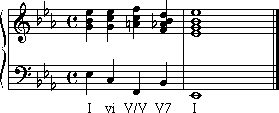
It is of course quite possible to create secondary
dominants in minor keys. Simply take any chord that naturally occurs as
something other than major, make it major, and you will have created a
secondary dominant. Here is an example:

In the first example, the i-chord leads quite nicely
to the iv-chord. However, by changing it to be a major chord (raising the
third), you create a secondary dominant, a chord that even moreso wants to
resolve to the iv-chord. The second example takes the ii-chord and makes
it major creating a secondary dominant V/V.
SUMMARY
We have seen that we can take the three
naturally-occuring minor chords from a major key - the ii-chord,
iii-chord, and vi-chord- and create secondary dominant chords by
simply making them major. We can do the same changes in chords from a
minor key. Our ear hears them as behaving like dominant chords because we
hear the raised third degree that wants to move to the root of the chord a
4th higher or fifth lower, just like dominant chords do. When we change
the structure of a chord in this manner, the name of the chord must
change. To call something a ii-chord means that the root of the chord is
based on the second degree of the scale and that it is
minor. By making it major, it cannot be a ii-chord anymore. Some people
are tempted to simply call it a II-chord (i.e., they use upper-case for the number) but this is
not correct. It must be renamed in the manner shown in this
lesson.
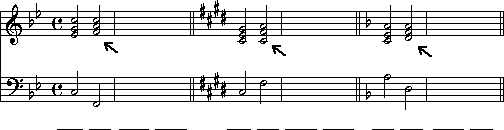
Before taking the quiz for this lesson, try the
following quick exercise. Rewrite each bar in the blank bar beside
it, changing the chords shown with an arrow into a secondary dominant
triad. Give the Roman Numeral Analysis for each chord. (Assume that
each excerpt is in the major key according to the given key signature.
Then click here to check your answers.
(Will open in new browser window)
 | 


 The Music Room