|
|
Note Number: |
Technical name: |
|
|
TONIC |
|
|
SUPERTONIC |
|
|
MEDIANT |
|
|
SUBDOMINANT |
|
|
DOMINANT |
|
|
SUBMEDIANT |
|
|
LEADING TONE |
When we speak of a note in a scale, we can refer to it by its number- 'G' is note number 1 of a G-major scale- or by its technical name- 'G' is the tonic note in a G-major scale. A technical name not only identifies a note, but can also give us information as to the function of a note within a scale. Further, we can build chords on all of the various notes in a scale, and identify those chords by the technical name. (i.e., a tonic chord)
In this lesson, we are only going to deal with tonic and dominant chords. This is because tonic and dominant chords form the basic backbone of much of what we call 'tonal music'. First we need to learn a couple of important definitions:
|
Chord: |
The simultaneous sounding of three or more notes. |
|
Triad: |
A three-note chord in which one note is identified as the root, another as the 3rd and the other as the 5th. |
A chord can be any three or more notes played
together, but a triad has a particular structure. If we are in the key of
A-major, this would be the tonic note:  If we build a triad on top of this note,
according to the definition of a triad given above, it would look like
this:
If we build a triad on top of this note,
according to the definition of a triad given above, it would look like
this:  This is a three-note chord in which the
bottom note is acting as the root, the middle one is the
3rd, and the top note is the 5th. Any chord with this
structure (root-3rd-5th) is called a triad. The numbers 3rd and 5th refer
to the intervals above the root. Those notes can appear in any order in
the triad, but this lesson will deal with triads where the root is on the
bottom.
This is a three-note chord in which the
bottom note is acting as the root, the middle one is the
3rd, and the top note is the 5th. Any chord with this
structure (root-3rd-5th) is called a triad. The numbers 3rd and 5th refer
to the intervals above the root. Those notes can appear in any order in
the triad, but this lesson will deal with triads where the root is on the
bottom.
We say that the triad shown above, built on the note
'A', is a tonic triad because it has been built on the tonic note
of the key we're in- A-major. It is traditional to indicate the triad by
using a Roman numeral. Since we have just built a triad on the first note
of the scale, we place the Roman numeral for '1' underneath
it: 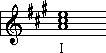
The procedure we just followed to create a tonic triad is the same for any key. Here are several keys, with tonic triads:

(It is traditional in most schools of theory to
indicate major triads with an upper-case 'I', and minor triads with a
lower-case 'i'.) These are tonic triads because they are chords
built on the tonic note. They are triads because the structure of
the chord is 1-3-5. (Root-3rd-5th)
Dominant triads are built in similar fashion as tonic triads.
In other words, simply go to the dominant note of the scale, and build a
1-3-5 triad. Let's take a good look at the structure of a dominant triad.
Note this one, in D-major::

We put the number ' V ' underneath it because it is a triad that has been built on the fifth note of the scale. Further, it is called a dominant triad, because the fifth note is the dominant note. In a dominant triad, there is always that leading tone, the middle note, that "wants" to move up to the tonic. That's what gives dominant chords their important place in traditional harmony: they help define the tonic chord in that manner.
IMPORTANT: Dominant triads must always be
major, no matter what key you write them in. Take a look again at the
V-chord above. You will see that the bottom note is the dominant note of
the key. The middle note is the leading tone of the key. (i.e., C# is the
leading tone in D-major.) This is important. Dominant chords must
always have the leading tone present. But look at this V-chord in
A-minor:  A leading tone is always a semitone, but
you can see that the leading tone in this triad (the middle note) is a
whole tone away from 'A'. So we have to raise the 'G' to become
'G#':
A leading tone is always a semitone, but
you can see that the leading tone in this triad (the middle note) is a
whole tone away from 'A'. So we have to raise the 'G' to become
'G#':  The simple way to remember this is to
remember this rule: "All dominant chords must be major. If you are in a
minor key, you must raise the third (middle) of the chord to make it
major." The G# is called an accidental. An accidental is a
sharp or flat symbol placed in the music that does not normally belong to
the given key.
The simple way to remember this is to
remember this rule: "All dominant chords must be major. If you are in a
minor key, you must raise the third (middle) of the chord to make it
major." The G# is called an accidental. An accidental is a
sharp or flat symbol placed in the music that does not normally belong to
the given key.
Here are some more dominant triads, in various keys:

The V-chords in the minor keys above had their middle notes (the 3rd) raised by using an accidental in order to create a leading tone to the tonic. For example, the 2nd chord has an E# because E# is a leading tone for the tonic (F#).
The quiz for this lesson mainly requires you to be able to build triads on either the tonic note or the dominant. The most important thing to remember is that if you are building dominant triads, they must always be major (in order to have a leading tone present).
Quiz
To take the quiz, click "Quiz" above, then print the resulting page and complete it.
 The Music Room The Music Room |
To Brebru.com |
To Band Pages |