 Introduction to Animation
 ANTICIPATION
ANTICIPATION
is an important principle in animation.. It is one of several devices
in animation derived from the genre of theater. Anticipations or "Antics"
precede most of the main movements in a scene. Most of the time the anticipation
is an action opposite to the main action. Anticipation pertains to movements
by humans, animals, objects, effects and graphics. Anything you can animate
can begin with as anticipation.
Anticipations have several purposes:
- They set up or telegraph your audience and let them know something is about to happen.
- They keep the audience with the character's actions.
- It helps the character, animal, object, effect or graphic build momentum.
- Most of the time, the anticipation matches the action. Big anticipation-big action; small anticipation small action.
Step 1
Say you want to animate
a character who jumps UP; the character mustfirst "antic" DOWN.
Take a look at the bouncing ball to illustrate an anticipation.
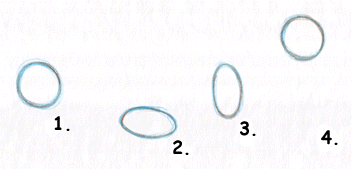
As you
can see in key drawing #1 - the ball in it's normal round shape.
In drawing #2 - we "antic" down. In this instance, we draw a squashed
ball shape to show the weight of the character.
TIP:
Animate in an opposite direction in most anticipations.
Follow with drawing #3, a stretched ball shape as
the character jumps into the air. In key pose drawing #4 the character
resumes it normal round shape.
Not all anticipations use squash..
Step 2
| Here we have a character grab a cup in four key drawings. In drawing #1, the character is at rest. Drawing #2 depicts an opposite action, as the character raises his hand. The next drawing, #3, the character presents his hand as he moves to grab the cup. Finally, in drawing # 4, the character has made contact with the cup. | 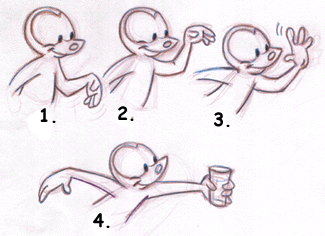 |
TIP:
ALWAYS look for good silhouettes in your key poses.
Spread the fingers as they near the cup.
To increase the impact or contact, go from the open position (with the
fingers spread) to the closed or contact position (with the hand around
the cup).
Step 3
 |
 |
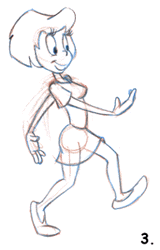 |
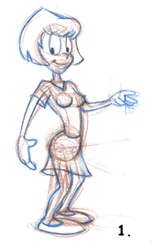
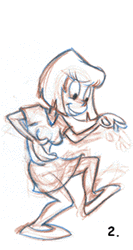
Again,
in drawing #1, the character is at rest. Drawing #2, the young lady does
a not-so-subtle anticipation. Then in drawing #3, she steps off.
Remember to follow the arcs when the key poses are inbetweened.
Review
KEY POINTS
|
TIPS
|
| To Next Page |