 Introduction to Animation
 CHARACTER
MODEL SHEETS
CHARACTER
MODEL SHEETS
Character
Model Sheets are the templates
of the characters used by the animation staff. They provide the construction,
structure, proportion, design, etc. for each character. Usually, several
models sheets are needed for each character to show the physical and design
nuances. Each animator, artist has their own style of drawing. The model
sheet guides the 300 or so artists working on the production toward making
all the characters look “ON MODEL”. “ON MODEL” means the model
sheets have been followed to perfection as if one artist (instead of over
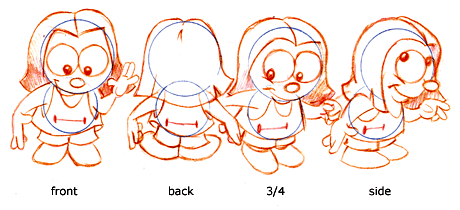
300 ) has drawn the character. Below is a Model Rotation - its purpose
to show the character from all sides.
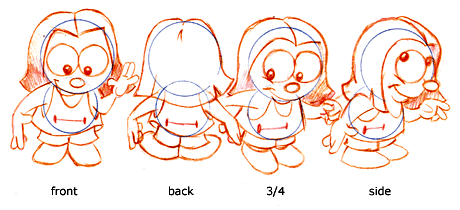
Notice how the character is draw in the front, profile (side), 3/4 and back views. This is called a CHARACTER ROTATION.
For this lesson we use a simple shaped character. A simple shaped character uses one basic shape or FORM for the main body of character.
Below are three options
you should consider for your character design. They are: a ball, a triangle
(or cone) and a combination - a ball and a cone. Please keep in mind the
dimensional aspects of your drawing - in other words what appear to be
SHAPES are really 3D FORMS.

PLEASE NOTE - Try to design people or animals...NO ALIENS, INSECTS OR ROBOTS! Draw the simple shapes in the views to match the characters rotation. When in doubt ALWAYS go back to basics.
A CHARACTER ROTATION should include a front view, back view, 3/4 view, and profile view of the character. These views help the animator (s) understand the character's construction and proportion. The rotation also insures the character design can be turned. The ability to turn a character is an element of animation which increases the character's believability.
The easiest and best way to draw out a Rotation is to break down the character into its simplest forms. .. then you just rotate the forms. Here the model sheet of Matt is distilled into simple forms. (Pads for the hands and feet, cylinders for the arms and legs, a ball for the body and a ball for the head.
Here's a design tip - make the ball of the head and the body different sizes (big head with small body or small head with a big body).
REMEMBER:
The head (and neck if seen) are ALWAYS on the FRONT side
of the body (refer to the Toon Institute lesson on Character Design for
more details).
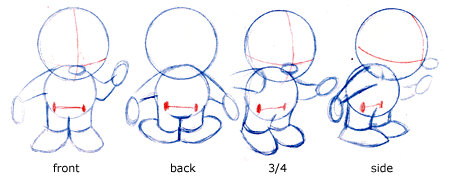
Once the basic forms are drawn - the details are drawn over top the forms.
REMEMBER:
Hair and fur are like carpeting over the form. Try to simplify the details
and apply basic rules of design. (check to make details, asymmetrical
and pay attention to your positive and negative space.
The next page of the MODEL SHEET involves a close-up with the details, proportions and structure of the characters head.
Use the same procedure
for the construction of the head as you did with the body. Begin with
the simple forms, then add the eyeline and center line and then layer
the details over top.
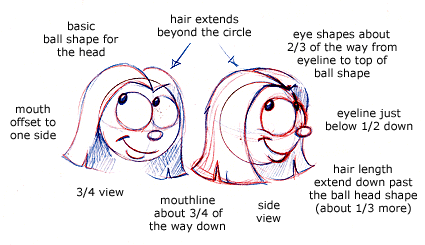
The eyes are anchored on top of the eyeline the nose or snout is anchored below the eyeline.
| The
third page of the CHARACTER MODEL SHEET is a page of 5 or 6
action poses of your character. This page is pure play! Its purpose
to to make sure the character works in action.
ALSO, really THINK about WHO your character is. The character is always defined by his or her or its NEEDS...and those needs are reflected in his or her or its ACTIONS. If you are not sure write a a short bio of your character. Please remember to NAME your character. |
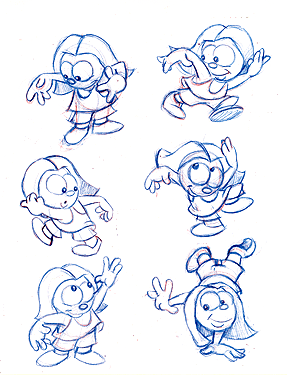 |
Try to keep your ACTION drawings quick, spontaneous and dynamic!
The LINE OF ACTION is a tool which can be pushed to create more dynamic poses. You might want to begin by sketching some thumbnails.
REMEMBER: Check your silhouettes for your action poses to make sure they “READ” as a graphic.
The concept of CHARACTER MODEL SHEETS is to provide enough information about the character, structure, and proportion so others can draw it. In fact, A good test is to give your MODEL SHEET to someone else to draw and see if they can draw your character design.
Review
TO RECAP
|
HINTS
|
| To Next Page |