 BreBru.Com
Helmholtz motion
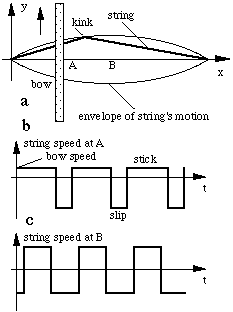
Helmholtz motion is the name given to the idealised motion shown in the animation above. (Strictly, it occurs only for an idealised, one dimensional string. Initially, we shan't worry about complications, but we'll mention a couple below).
At all times, the shape of the string is two straight lines, joined by a kink that travels around the envelope shown, which is made of two parabolic segments. For a bow moving upwards, the kink travels anti-clockwise, as shown in the animation.
In the graphs of velocity vs time t, let's say that at the bowing point
(A), an upwards moving bow starts the stick phase at time t = 0. So at t = 0, v is positive, as shown in figure b.
While the string and bow move together, the kink travels to the right hand end of the string, reflects and returns (check this on the animation).
When the kink returns to A, there is a large transient force on the string (the tension on both sides of the string now has downwards components). This starts the slip phase (v < 0 in figure b) during which the kink travels to the left hand end, is reflected and returns to the bow, ready to being the stick phase again.
At the midpoint of the string (B), the up and down speeds are equal (figure c). Now we can work out the displacement of the string at the bowing point. The kink travels at a constant speed V.
Let the string's length be L.
If the frequency is f so one cycle takes time 1/f. So the kink travels 2L in time 1/f so V = 2Lf.
Suppose we are bowing it at a position L/n from the closer end, usually the bridge. During the stick phase, the kink travels to the far end and back, a distance D = 2L(n-1)/n.
At speed V, this takes a time D/V = 2L(n-1)/nV = (n-1)/nf.
Now the bow speed is v, so during the stick phase the bow and the string together travel a distance A = v(n-1)/nf, where A is the amplitude of the motion of the string at the bowing point.
So, at the same bowing position, the amplitude of the motion is proportional to the bowing speed and inversely proportional to the frequency. (In the animation above, v and f are both very small.)
So, if you bow with greater speed, the stick point will travel further and the amplitude will be greater. This of course makes it louder, which is what conductors want when the say "use more bow".
If you vary the bowing position but keep the bow speed constant, you are changing only n and A in the equation above.
Measuring the bowing position from the closer end of the string means that n can vary between 2 and a large number. So the amplitude at the bowing position increases from v/2f if you bow at the middle, towards v/f as you get close the bridge.
However, the maximum amplitude of the string's motion is greatest at the middle. As you move the bowing point towards the bridge, the maximum amplitude of the string increases for this reason as well.
The diagram and the explanation above are simplified.
Bow force comes into this because, for a given bowing speed and bowing
position, there is only a certain range of bow force that will maintain
Helmholtz motion. For a given bowing speed, the required force is a little
higher as you bow closer to the bridge.
Further, the permitted range becomes narrower, so you must judge the force more accurately. The pay-off is that, with more applied force, you excite more higher harmonics so the tone is brighter and richer.
For bowing harmonics, the story is more complicated. For the second harmonic, there are two cycles of stick slip in the time that a kink takes to make one complete return trip along the string. However, there are two kinks travelling at any time, L/2 apart. Each time one of them arrives at the bow after a reflection from the distant end, it initiates a slip. When it arrives from a reflection at the closer end, it initiates a stick phase.
Now let's return to address some of the complications neglected above. A real bowed string never passes through a position where it is completely straight. Instead, it retains a small displacement at the bow in the bowing direction. The sharp corner of the kink produces all of the harmonics, except for those that have a node at the bowing point. However, because a string has a certain stiffness, the kink is never perfectly sharp and the finite curvature limits the number of upper harmonics. Bowing with greater force (usually closer to the bridge) gives a sharper kink and therefore more high harmonics and a brighter tone.