Answers for Quiz from Lesson #26 (Secondary Dominant Triads)

PRINT THIS PAGE (HARDCOPY) AND COMPLETE. AFTER WRITING THE QUIZ, CHECK YOUR ANSWERS BY CLICKING ON THE "QUIZ ANSWER PAGE" LINK AT THE BOTTOM OF THE PAGE .

1. Fill in the blanks:

a) When you make a minor chord major, you are creating a secondary dominant .

b) What is the roman numeral for a triad built on the second note of a scale, that has been made to be major:

Answer: V/V

c) What is the roman numeral for a triad built on the third note of a scale, that has been made to be major:

Answer: V/vi

d) What is the roman numeral for a triad built on the sixth note of a scale, that has been made to be major:

Answer: V/ii


2. Give the roman numeral analysis of the given chord. Then rewrite the chord, making it a secondary dominant, and give the new roman numeral:


3. Here are the letter-names of some triads. Some may be secondary dominants. Give the proper roman numeral analysis of each triad. The first one has been done for you:


a) D+: G-B-D= IV


b) Ab+: Ab-C-Eb= I


c) Db+: Eb-G-Bb= V/V


d) A+: F#-A-C#= vi


e) C+: A-C#-E= V/ii


f) E+: F#-A#-C#= V/V


g) Bb+: D-F#-A= V/vi


h) B+: D#-F#-A#= iii


i) F+: G-B-D= V/V


j) C#+: E#-Gx-B#= V/vi

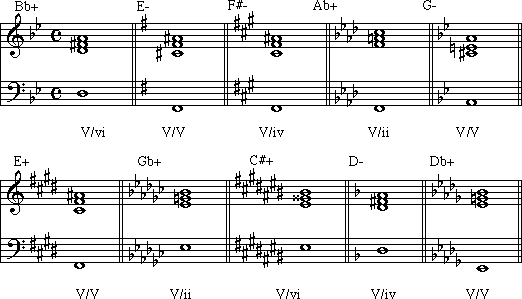
4. Write the requested chords according to the key and roman numerals given. Use one note in the bass clef (the root) and three notes in close spacing in the treble clef:

NOTE: There are many possible correct answers to each one. The letter names you see below in each answer should be in your answers, but not necessarily in the order or spacing you see here.

-Back to index- On to -next lesson-

The Music Room
To Brebru.com
To Band Pages