The Music Room The Music Room |
To Brebru.com |
To Band Pages |
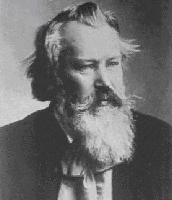
Johannes Brahms (1833-1897)
(born Hamburg, 7 May 1833; died Vienna, 3 April 1897).
He studied the piano from the age of seven and theory and composition (with Eduard Marxsen) from 13, gaining experience as an arranger for his father's light orchestra while absorbing the popular alla zingarese style associated with Hungarian folk music. In 1853, on a tour with the Hungarian violinist Reményi, he met Joseph Joachim and Liszt; Joachim, who became a lifelong friend, encouraged him to meet Robert Schumann. Brahms's artistic kinship with Robert Schumann and his profound romantic passion (later mellowing to veneration) for Clara Schumann, 14 years his elder, never left him. After a time in Düsseldorf he worked in Detmold, settling in Hamburg in 1859 to direct a women's chorus. Though well known as a pianist he had trouble finding recognition as a composer, largely owing to his outspoken opposition - borne out in his d Minor Piano Concerto op.15 - to the aesthetic principles of Liszt and the New German School. But his hopes for an official conducting post in Hamburg (never fulfilled) were strengthened by growing appreciation of his creative efforts, especially the two orchestral serenades, the Handel Variations for piano and the early piano quartets. He finally won a position of influence in 1863-4, as director of the Vienna Singakademie, concentrating on historical and modern a cappella works. Around this time he met Wagner, but their opposed stances precluded anything like friendship. Besides giving concerts of his own music, he made tours throughout northern and central Europe and began teaching the piano. He settled permanently in Vienna in 1868.
Brahms's urge to hold an official position (connected in his mind with notions of social respectability) was again met by a brief conductorship - in 1872-3 of the Vienna Gesellschaftskonzerte - but the practical demands of the job conflicted with his even more intense longing to compose. Both the German Requiem (first complete performance, 1869) and the Variations on the St. Antony Chorale (1873) were rapturously acclaimed, bringing intemational renown and financial security. Honours from home and abroad stimulated a spate of masterpieces, including the First (1876) and Second (1877) Symphonies, the Violin Concerto (1878), the songs of opp.69-72 and the C major Trio. In 1881 Hans von Bülow became a valued colleague and supporter, 'lending' Brahms the fine Meiningen court orchestra to rehearse his new works, notably the Fourth Symphony (1885). At Bad Ischl, his favourite summer resort, he composed a series of important chamber works. By 1890 he had resolved to stop composing but nevertheless produced in 1891-4 some of his best instrumental pieces, inspired by the clarinettist Richard Mühlfeld. Soon after Clara Schumann's death in 1896 he died from cancer, aged 63, and was buried in Vienna.
Fundamentally reserved, logical and studious, Brahms was fond of taut forms in his music, though he used genre distinctions loosely. In the piano music, for example, which chronologically encircles his vocal output, the dividing lines beteen ballade and rhapsody, and capriccio and intermezzo, are vague, such terms refer more to expressive character than to musical form. As in other media, his most important development technique in the piano music is variation, whether used independently (simple melodic alteration and thematic cross-reference) or to create a large integrated cycle in which successive variations contain their own thematic transformation (as in the Handel Variations).
If producing chamber works without piano caused him difficulty, these pieces contain some of his most ingenious music, including the Clarinet Quintet and the three string quartets. Of the other chamber music, the eloquent pair of string sextets, the serious C minor Piano Quartet op.60 (known to be autobigraphical), the richly imaginative Piano Quintet and the fluent Clarinet Trio op.1l4 are noteworthy. The confidence to finish and present his First Symphony took Brahms 15 years for worries over not only his orchestral technique but the work's strongly Classical lines at a time when programmatic symphonies were becoming fashionable; his closely worked score led him to be hailed as Beethoven's true heir. In all four symphonies he is entirely personal in his choice of material, structural manipulation of themes and warm but lucid scoring. All four move from a weighty opening movement through loosely connected inner movements to a monumental finale. Here again his use of strict form, for example the ground bass scheme in the finale of the Fouth Symphony, is not only discreet but astonishingly effective. Among the concertos, the four-movement Second Piano Concerto in B-flat - on a grandly symphonic scale, demanding both physically and intellectually - and the Violin Concerto (dedicated to Joachim and lyrical as well as brilliant) are important, as too is the nobly rhetorical Double Concerto.
Brahms's greatest vocal work, and a work central to his career, is the German Requiem (1868) combining mixed chorus, solo voices and full orchestra in a deeply felt, non-denominational statement of faith. More Romantic are the Schicksalslied and the Alto Rhapsody. Between these large choral works and the many a cappella ones showing his informed appreciation of Renaissance and Baroque polyphony (he was a diligent collector, scholar and editor of old music) stand the justly popular Zigeunerlieder (in modified gypsy style) and the landler-like Liebeslieder waltzes with piano accompaniment. His best-loved songs include, besides the narrative Magelone cycle and the sublime Vier ernste Gesänge, Mainacht, Feldeinsamkeit and Immer leiser wird mein Schlummer.
Timeline
1833 Born 7 May in Hamburg, Germany
1840 Begins studies with Otto Cossel
1845 Begins studies with Edward Marxsen
1848 First public performance as a solo pianist
1853 Meets Hungarian violinist Remenyi (Eduard Hoffmann) and they tour through North Germany: to Hanover and Göttingen where Brahms meets German violin virtuoso Joseph Joachim. They then travel on to Weimar, where Brahms meets Franz Liszt. Brahms then leaves Remenyi for Düsseldorf and on 31 October he meets Robert and Clara Schumann. Schumann's article Neue Bahnen appears in the Neue Zeitschrift für Musik. Brahms then moves on to Leipzig for performances of his compositions and later returns to Hamburg
1854 Accepts position as Director of Court Concerts and Choral Society for the Prince of Lippe-Detmold. In February, Robert Schumann has a breakdown, and Brahms returns to Düsseldorf
1856 29 July: Robert Schumann dies
1857 Brahms returns to Hamburg. On the way, he spends four months in Detmold (a visit repeated in the autumn of the next two years), where he worked as court pianist, chamber musician, and Conductor of the Court Choir
1858 Gives up the Lippe-Detmold appointment. Spends March and April in Berlin with Clara Schumann, and the summer in Göttingen where he meets Agathe von Siebold
1859 Mostly in Hamburg
1860 Moves to Winterthür, to be near Theodor Kirchner
1861 Visits Vienna, then travels to Hamm (near Hamburg)
1862 June: Attends the Rhein Music Festival in Köln, combined with a visit to Clara Schumann in Münster am Stein. In July, goes back to Hamburg, and in September, takes up permanent residence in Vienna and becomes the Conductor of the Weiner Singakademie. Meets Richard Wagner and Elisabeth von Stockhausen
1863 1 May: Left Vienna for Hamburg for his 30th birthday, but on the way returned to Blankensee, as Stockhausen was offered the job in Hamburg Brahms had wanted. By the end of May he was back in Vienna for the Singakademie
1864 Resigns his post as Director of the Singakademie and in mid-June returns to Hamburg for a visit
1865 31 January: Brahms's mother diesIn February he travels to Karlsruhe, Winterthür and Zürich
1866 August: to Zürich and Baden-Baden
1868 Settles permanently in Vienna, after having toured with Joachim and Stockhausen throughout Germany, Austria, Hungary, Switzerland, Denmark and the Netherlands. In May he travels again to Hamburg
1872 11 February: Brahms's father diesIn September Brahms accepts a position as Conductor of the Gesellschaft der Musikfreunde
1873 In the summer, visits Starnberger See
1874 Summer: In Rüschlikon, Ziegelhausen, Sassnitz, Hamburg, and Lichtenthal. Meets Max Kalbeck
1875 18 April: Resigns as conductor of the Gesellschaft der Musikfreunde. In the summer travels as previous summer, and develops his friendship with poet Gottfried Keller
1876 Summer: as in 1874 and 1875. Also travels to Mannheim. At Rügen meets Henschel. In December travels back to Vienna
1877 Concerts in Leipzig, and reunion with Elisabeth von Herzogenberg. Summer in Portschach am Wörthersee with Elisabeth von Herzogenberg
1878 Visit to Leipzig; summer as in 1877. In the late summer, travels to Hamburg for concert of his works
1880 May in Bonn for the unveiling of Schumann's memorial, and visit with Clara Schumann. Spends the summer in Bad Ischl
1881 February: Offered Meinigen court orchestra as a 'rehearsal orchestra', and at the end of the year travels to Meinigen
1882 January in Berlin; spring in Vienna: and summer in Bad Ischl
1883 Summer in Wiesbaden where he meets Hermine Spies
1884 Summer in Meinigen, then to Mürzzuschlag
1885 October in Meinigen for the rehearsal of his Fourth Symphony. Immediately after takes a tour through Germany and the Netherlands
1886 This summer is the first of three summers in Hofstetten on Lake Thun
1887 Death of Edward Marxsen. Brahms interupts his summer visit in Hofstetten to visit Clara Schumann in Frankfurt
1889 Brahms appointed a "Freeman of Hamburg". From this year onward, spends his summers in Bad Ischl
1890 October: Began 'cleaning house', and destroying incomplete works or abandoned compositions
1892 Death of Brahms's sister Elise; death of Elisabeth von Herzogenberg
1893 Death of Hermine Spies
1895 Death of Brahms's brother Fritz; death of Billroth. Brahms's last visit to Switzerland
1896 21 May: Clara Schumann dies in Bonn. In September Brahms goes to Karlsbad for treatment
1897 26 March: Brahms is bedridden in Vienna, and on 3 April he dies