

| Guitarrón | 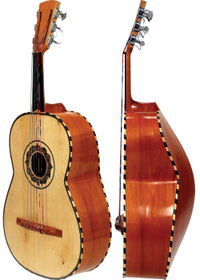 |
The guitarrón (literally "large guitar"
in Spanish, the suffix "-ón" denoting "large")
is a very large, deep-bodied Mexican 6-string acoustic bass played in
mariachi bands. Although obviously similar to the guitar, it is not a
derivative of that instrument, but was independently developed from the
sixteenth-century Spanish bajo de uña. It achieves audibility by
its great size, and does not require electric amplification for performances
in small venues. The guitarrón is fretless, the strings are heavy
gauge, and the action is high, so that quite a bit of left hand strength
is required. The guitarrón is played by plucking always DOUBLE
STRING (one octave between), which is facilitated by the unusual tuning
A D G C E A with the high A lowered an octave putting it just one octave
above the low A.
The guitarrón was the inspiration behind Ernie Ball's development
of the first modern acoustic bass guitar, released on the market in 1972.
There is a also four-string model in Mexico which originated in the isthmus
of Tehuantepec. Some of the prominent mexican guitarron makers are Humberto
Zavala Ildefonso, Humberto Morales of Guadalajara and Luis Espinosa of
Michoacan.
·
·
Traditional uses
The guitarrón is used in Mexican Mariachi groups,
which usually consist of at least two violins, two trumpets, one Spanish
guitar, and a vihuela (a high-pitched, five-string guitar), in addition
to the guitarrón. Some larger Mariachi groups have more than twenty
musicians. The original Mariachi were Mexican street musicians or buskers,
but now most Mariachi musicians work in the mainstream entertainment industry.
It should be noted that the Mexican Mariachi's influence has been growing
in popularity especially in Argentina, Colombia, Spain and Germany. Argentina
is adopting it as part of the music mainstream. An Argentinan based Mariachi
group has been established in Buenos Aires, Argentina as known by Mariachi
Sol Aztec.
In the United States there are as many as 500 Mariachi bands or more,
Texas being the more populated followed by California, but even in states
as remote a New York there are at least 5 bands. Mariachi Citlalli is
one of the most prestigious in New York; [MariachiNewYork.com]
In other states where the Latin population is growing there are other
bands that are very notorious. Mariachi music has expanded to an international
level, braking the barrier of languages and traditions.
Non-traditional uses
· The guitarrón is played by Roy Estrada
on the 1966 Mothers of Invention album Freak Out!.
· Randy Meisner of The Eagles also plays the guitarrón on
the track "New Kid In Town" from the album Hotel California
(1976).
· Another American player using the guitarrón in a non-traditional
context is Aaron Goldsmith of the New York-based multicultural acoustic
ensemble Luminescent Orchestrii; he uses a modified guitarrón with
an elongated neck that allows him to play more melodically.
· The guitarrón was a defining element of the 1980s Scottish
folk-pop band Fairground Attraction.
Variations
Travelling through the Spanish countryside in the early
1600s, Cervantes (the "Spanish Shakespeare') described a large guitar,
the "Bajo de uña" or "Fingernail Bass." It
is likely that this instrument found its way to the new Spanish colonies
in the Americas and survives today in several countries: at least two
variants in Mexico, at least one in Argentina and one in Puerto Rico.
Puerto Rico
In Puerto Rico a large six-string instrument was described
by Manuel Alonso in the mid-1800s. The instrument formed part of the traditional
string ensemble of the time called "orquesta jíbara,"
which played in salon society. The instrument became popular at the turn
of the century as a deep-voiced melody instrument when it changed form
and stringing to 4 and then 5 octaved double courses. By the twenties
and thirties it had grown to be almost seven inches deep, and was known
for it unique "quivering" tone, and it was sometimes known as
the "weeping bordonua." It was large and odd-looking and was
replaced in the "orquesta jibara" by the guitar.
For all musical purposes the instrument became obsolete until the fifties
when the great Puerto Rican musician and folklorist Paquito Lopez Cruz
began to teach its technique once again, after the government began a
series of yearly contests in order to urge makers to build bordonuas...and
as well, several other disappeared instruments, besides. The instrument
is almost ubiquitous once again today, and is often seen in the back row
of the many community string orchestras which can be seen around the island
today.

Chile
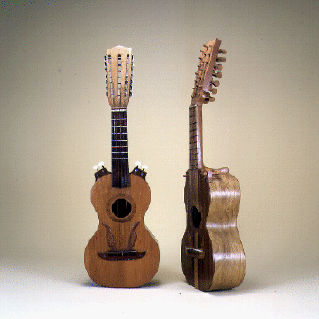
Yes, there exists an oddly-configured Guitarron Chileno.
I am currently seeking more information about this unusual instrument
which features a series of resonating strings which are stretched across
its face, besides the usual plucked strings across its neck. I was able
to obtain this beautiful photograph from FUNDEF, a South American Instrument
research organization.
.
Argentina
The Guitarrón Argentino is not much more than a
giant classic guitar, with a tradition within the Tango ensembles. The
following photograph shows Alvaro Castillo of the Quinteto Arrabal with
his guitarrón.
