Unless you plan on working in building systems for the internet you will most likely not need to learn HTTP.
HTTP is a specialized language for one purpose only. HTML is a markup language that is different from languages of the past like:
1957 A new language, FORTRAN (short for FORmula TRANslator), enabled a computer to perform a repetitive task from a single set of instructions by using loops. The first commercial FORTRAN program ran at Westinghouse, producing a missing comma diagnostic. A successful attempt followed.
1959 ERMA, the Electronic Recording Method of Accounting, digitized checking for the Bank of America by creating a computer-readable font. A special scanner read account numbers preprinted on checks in magnetic ink.
1960 A team drawn from several computer manufacturers and the Pentagon developed COBOL, Common Business Oriented Language. Designed for business use, early COBOL efforts aimed for easy readability of computer programs and as much machine independence as possible. Designers hoped a COBOL program would run on any computer for which a compiler existed with only minimal modifications.
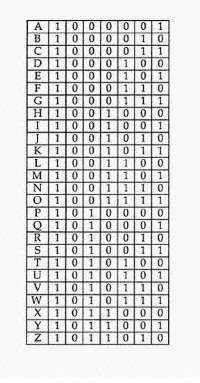
1963 ASCII -- American Standard Code for Information Interchange -- permitted machines from different manufacturers to exchange data. ASCII consists of 128 unique strings of ones and zeros. Each sequence represents a letter of the English alphabet, an Arabic numeral, an assortment of punctuation marks and symbols, or a function such as a carriage return.
1964 Thomas Kurtz and John Kemeny created BASIC, an easy-to-learn programming language, for their students at Dartmouth College.
1985 The C++ programming language emerged as the dominant object-oriented language in the computer industry when Bjarne Stroustrup published "The C++ Programming Language." Stroustrup, at AT&T Bell Laboratories, said his motivation stemmed from a desire to write event-driven simulations that needed a language faster than Simula. He developed a preprocessor that allowed Simula style programs to be implemented efficiently in C.
HTML is a simple, yet powerful use of normal language that incoporates "TAGS."
1990 The World Wide Web was born when Tim Berners-Lee, a researcher at CERN, the high-energy physics laboratory in Geneva, developed HyperText Markup Language. HTML, as it is commonly known, allowed the Internet to expand into the World Wide Web, using specifications he developed such as URL (Uniform Resource Locator) and HTTP (HyperText Transfer Protocol). A browser, such as Netscape or Microsoft Internet Explorer, follows links and sends a query to a server, allowing a user to view a site. Berners-Lee based the World Wide Web on Enquire, a hypertext system he had developed for himself, with the aim of allowing people to work together by combining their knowledge in a global web of hypertext documents. With this idea in mind, Berners-Lee designed the first World Wide Web server and browser -- available to the general public in 1991. Berners-Lee founded the W3 Consortium, which coordinates World Wide Web development.
To See Maps of the Development of the Web