
|
|
2.1 THE DIGITAL CAMERA | ||
 Learn
To Draw Learn
To Draw |
Learn
To Paint |
Photoshop
Elements |
Animation
Menu |
Art
Principles |
Art
Appreciation |
Digital photography begins with you capturing images. You can do this with a film camera and then have the slides, negatives, or prints scanned. However, it's faster and easier to capture images with a digital camera that immediately gives you the images in digital form.
Although the technical process of digital photography is dramatically different from film-based photography, digital cameras are not that much different from film cameras. In most cases, digital camera manufacturers have attempted to retain many of the familiar features of traditional film cameras in their newer digital cameras. For example, lenses, shutters, and exposures are relatively unchanged. The biggest difference is the replacement of the film with a solid-state image sensor—usually a charge-coupled device (CCD).
 |
Some digital cameras don't look at all like film cameras. |
Let's now look at the types, or families, of digital cameras currently available. As we do so, keep in mind is that no one yet knows what a digital camera should look like so you'll find all kinds of strange shapes. 35mm cameras have taken their familiar forms because they require room for the film and light path as well as prisms and such. Digital cameras are freed from many of these limitations so they can take new forms. During these early days, some manufacturers make their cameras look like familiar 35mm cameras, others veer off in new directions. Regardless of what they look like, the digital camera market is divided into two distinct segments; the consumer and professional markets. Let's take a look at these categories.
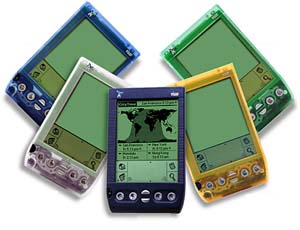 |
Digital camera are rapidly being integrated into other devices. For example, Handspring's™ handheld computers have a Springboard™ expansion slot. Soon you'll be able to plug in a Springboard digital camera module. |
The largest market for cameras is the consumer market. Within this category is a wide spectrum of cameras ranging from point and shoot type cameras all the way up to sophisticated cameras with professional-like creative controls.
Point and shoot cameras are generally small and inexpensive (at least in relative terms). They are fully automatic and usually don't provide a lot of overrides that give you creative control—that's why they are called "point and shoots." At the low end of this category are cameras with lower resolution whose images are limited to about 4 x 6 inches or so. Despite this small size, the images are ideal for Web pages and e-mail attachments.
 |
The Nikon Coolpix 700 is a high-quality point and shoot camera with over 2-million pixels. Courtesy of Nikon. |
Positioned between the inexpensive point and shoot cameras and the very expensive professional cameras discussed next is a family of cameras based somewhat on the 35mm SLR model but designed exclusively for digital photography. These cameras, sometimes called prosumer cameras, currently have 2-megapixels or more. Generally, the higher resolution is combined with more advanced features such as through-the-lens (TTL) focusing, various exposure modes, and manual overrides of otherwise automatic controls such as focus and white balance. This is one of the fastest growing categories because these cameras appeal to serious amateur photographers and professionals who want creative control of their camera settings and prints up to about 8 x 10 in size.
 |
The Nikon 950 is typical of the high-end consumer cameras. Courtesy of Nikon. |
Professional 35mm SLR or APS cameras have been adapted or used as models by replacing the film mechanism with an image sensor. These multi-megapixel cameras usually have more than 2-million pixels in their image sensors, with some having 6-million or so. The big advantage of these cameras is not just the quality of the images they take, but also the accessories that are available. Any lenses that work with the film-based camera also work with the digital version. Also, almost all of the features that are available in the film-based version are available on these digital models.
 |
Nikon's D1 has a large 23.7 x 15.6mm 2.74-megapixel CCD for 2,012 x 1,324-pixel images. Courtesy of Nikon. |
Most advertising and many fine art photographs are taken with large format cameras. The large image size gives sharper images with brighter colors because it requires much less enlargement. In the digital camera arena, these medium and large format cameras are usually equipped with removable digital backs.
 |
Large format hand-held cameras used to be very popular. Here's Jack Delano, a photographrer for the Farm Security Administration/Office of War Information holding such a camera. Courtesy of the Library of Congress. |
 |
BetterLight's digital back works with any 4x5 view camera, lenses, and accessories It inserts into the camera just like a film holder. One model scans 16 bits per color at a resolution of 8000 x 10640 creating a 244 MB RGB image file. Courtesy of BetterLight. |
Because quality is of paramount importance in medium and large format photography, different technologies are often used. One way to improve quality is to use three image sensors instead of one, one for each of the colors red, green, and blue; or more likely, cyan, yellow, and magenta. Another approach is to use a single image sensor but make three passes for each image with a different color filter over the image sensor for each pass. Both approaches call for long exposure times and subjects that don't move—or even blink. The three separately captured image files can then be combined for a full color image or kept separate for printing purposes. In the minds of some people, this technology has reached the same standard as traditional film photography.
 |
Businesswire.com features current stories and press releases on digital cameras. To see what's happening as you read this, click the More Info button. |