| BreBru's Art Room | |
 BreBru.com BreBru.comExtra Info Music Room ArtRoom |
1-4 SUNRISE, SUNSET AND WAVE |
| When the sun is low
its rays pass across the curved surface of the earth and encounter
the thickest film of atmosphere than at any other point during the
day .
The shorter light rays (the blue end of the spectrum) are almost entirely deflected by the heavier particles in the atmosphere whereas the reds and oranges (the longer wave lengths) are the ones that will reach the observer. Under certain conditions, like after a rainstorm, the sunsets can be bluer whereas after a fire they often become redder. It all depends on the 'thickness' of the atmosphere.
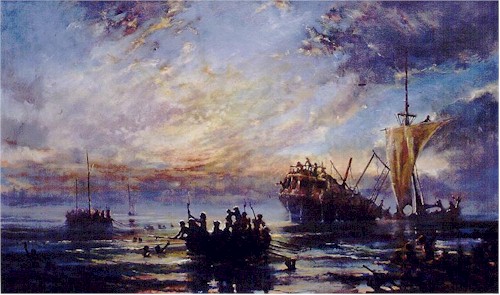
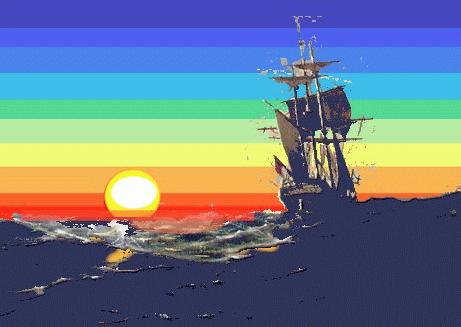
When the sun tries to penetrate the atmosphere, or clouds near the horizon, we notice that the thicker the mist (atmosphere) the deeper the red. Thinner mists will produce orange, then even thinner, golds and finally yellows. You can decide for your self why some sailors say red sunsets bode a fine day ahead? The red light sometimes strikes the underside of the clouds directly overhead and turns them red, yellow and orange depending on the wave lengths of light that have managed to penetrate the soup of the earth's atmosphere. Let us now apply these principles to painting...
To be completely brutal and simplistic see below... but you get the idea of the theory! STUDENT ACTIVITY: Using strips of multi-colored cellophane (semi-transparent) paper and two small cut out 'images' construct an atmospheric 'collage' over a white background. Cut hole for sun. Allow 40min.
... its all so much easier (and subtle) using oil paint. 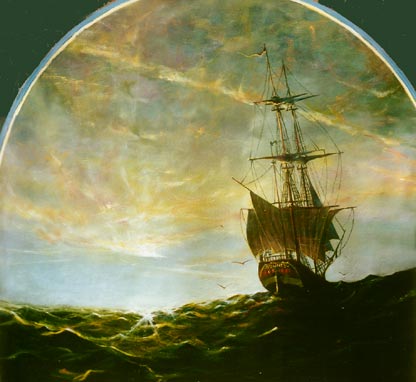
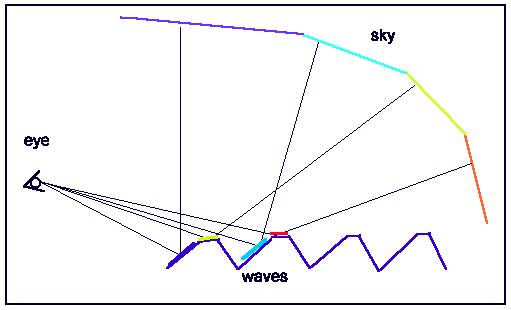
STUDENT ACTIVITY: Copy the diagram above and find a suitable photograph that illustrates this phenomena. Also read lesson on 'waves' in the advanced section.
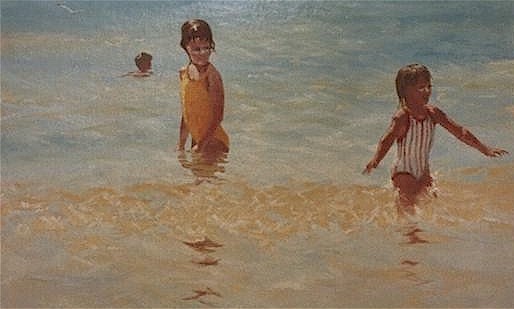
Sometimes the sea will become transparent and the sand begins to
show through - in this
From the information shown here you should be able to map all the
colors of the sky although you don't see the sky itself. we look away from a sunset or sunrise |
|
| |
|